Inside a 43-foot-tall payload fairing at Launch Complex 39A sits an observatory weighing about 18,000 pounds. Its primary mirror is finished to nanometer tolerances, and its camera must measure galaxy shapes without confusing optical error for invisible matter. For now, that precision is bolted to a machine built to shake the ground.
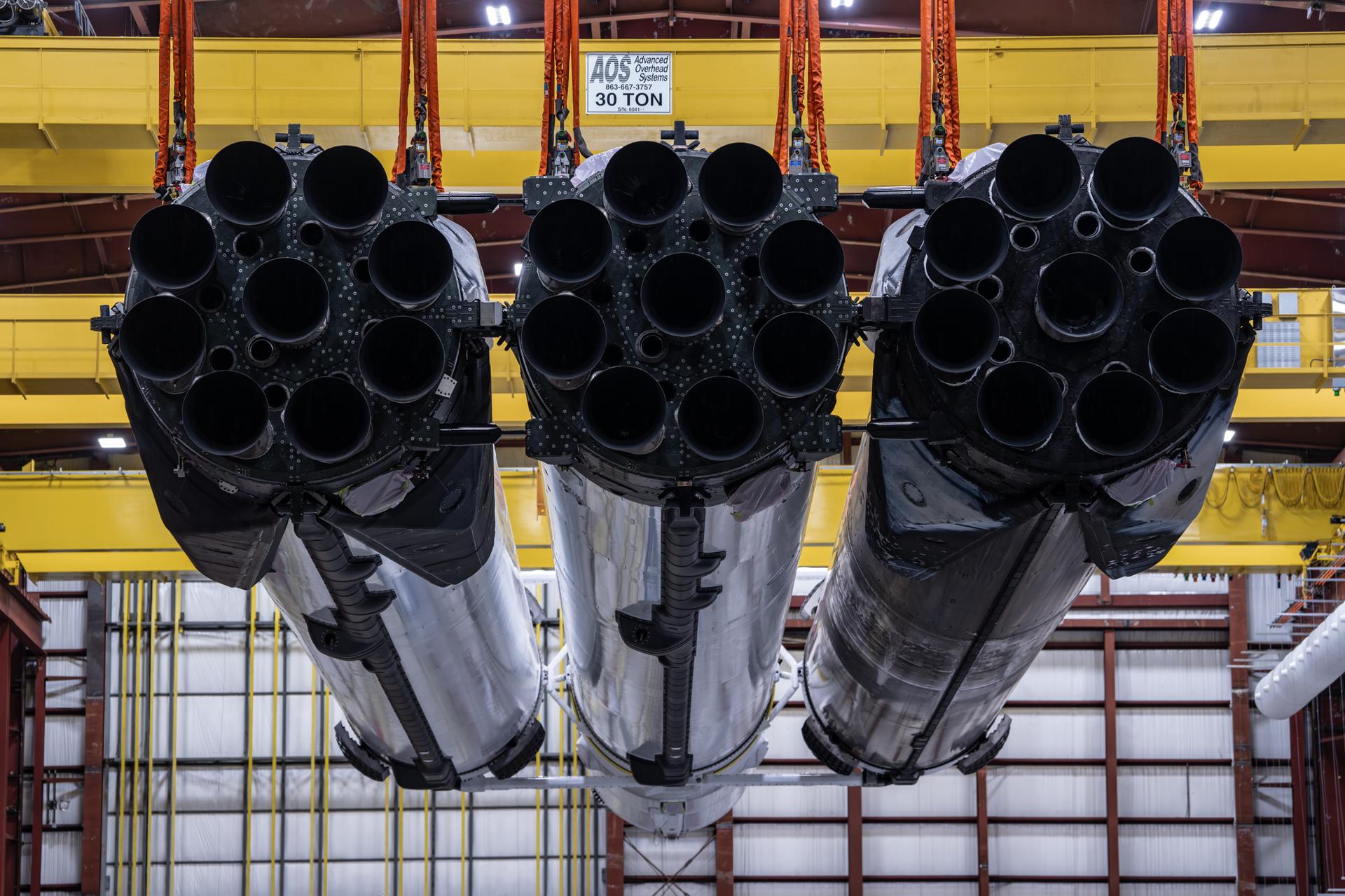
Beneath Roman are three Falcon 9-derived cores and 27 Merlin engines, together capable of more than 5 million pounds of thrust. The first minutes bring combustion, vibration, maximum aerodynamic pressure, booster separation and fairing jettison. The fairing is a temporary acoustic, aerodynamic and thermal environment protecting a school-bus-size metrology instrument until the atmosphere thins. NASA's fairing update and August 29 pad report document the configuration; NASA's press kit gives Roman's mass.
SpaceX's flight profile places separation roughly 31 minutes after liftoff. Roman would then begin an approximately month-long outward cruise, within a 90-day campaign of deployment, correction and calibration, toward a halo orbit around Sun-Earth L2 about 930,000 miles away. Five million pounds of thrust will send an instrument to measure changes in light and shape that are barely there. NASA's 2026 press kit gives the commissioning sequence.
The width of the sky
Roman is not designed to see farther than every telescope before it. Webb's 6.5-meter segmented mirror gathers more light and resolves finer detail at a given wavelength than Roman's 2.4-meter mirror, while reaching farther into the infrared. Hubble, also with a 2.4-meter mirror, remains uniquely capable in ultraviolet and visible light and excels at chosen targets. Roman's distinction is how much sharp sky it measures at once. NASA's Roman-Webb and Roman-Hubble comparisons describe the complementary roles.
Telescope design is a negotiation. A larger aperture gathers photons faster and narrows the diffraction pattern, whose characteristic angular scale is about 1.22 times wavelength divided by diameter. It does not automatically provide a large field. Wide coverage requires optics corrected far from the axis, a broad focal surface, many detectors, readout electronics, heat rejection and data handling. Wavelength range changes coatings, detector materials and temperature. The bill arrives as mass, power, cost or fairing volume.
These demands couple. Extending the focal plane increases the number of simultaneous sources, but also the number of detector boundaries, gain variations and pixels requiring calibration. Broadening the infrared range makes dust-obscured and redshifted objects accessible, while increasing the need to keep warm hardware from glowing into the measurement. The engineering objective is not to maximize each variable independently. It is to build a combination that produces the most defensible measurements per unit observing time.
Astronomers capture part of this balance with étendue, collecting area multiplied by solid angle on the sky. Mirror diameter describes only the first factor. A survey telescope with ample area and a large angle can outpace one that tiles the same region through narrow pointings. Throughput, noise, background, wavelength and overhead also matter, but étendue explains Roman's speed without invoking astronomy's largest mirror.
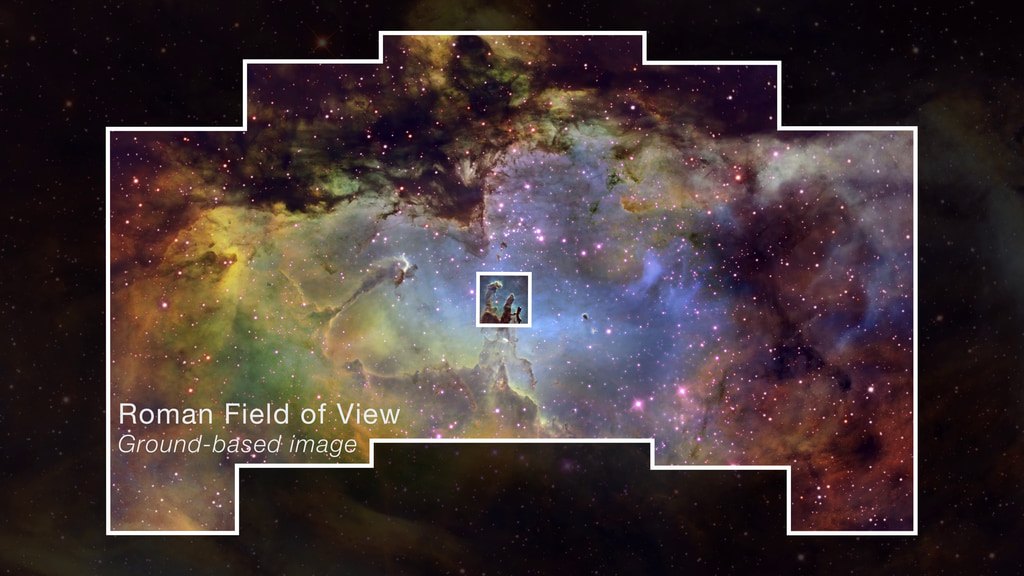
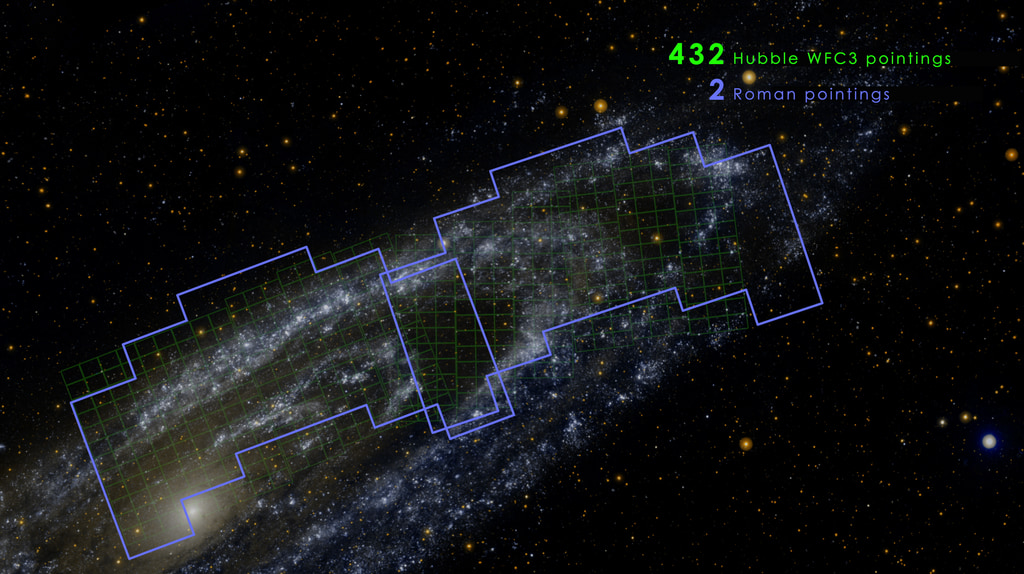
Roman's aperture is approximately Hubble's size, but its Wide Field Instrument, or WFI, sees 0.281 square degree at once, larger than the apparent full Moon. Compared with Hubble's Advanced Camera for Surveys its field is nearly 100 times larger; against Wide Field Camera 3's infrared channel it is about 200 times larger. Both claims can be honest. Neither means 100 times the resolution or sensitivity. The compared property is field of view. NASA's WFI overview makes the distinction.

This changes the division of labor without demoting Hubble or Webb. They can dissect a selected galaxy, atmosphere or explosion. Roman can find the unusual object, measure its surroundings and learn whether it belongs to a population. Hubble gave astronomy extraordinary portraits. Roman is built for the census, then for handing its most revealing entries to deeper observers.
A camera designed for repetition
WFI's focal plane contains 18 Teledyne H4RG-10 near-infrared arrays, each 4,096 pixels per side. NASA's formal specification is 288 megapixels, while public pages round to 300. More important, the corrected mosaic samples the sky at 0.11 arcsecond per pixel. NASA's technical reference gives the layout, field and sampling; the FAQ gives 288 megapixels.
The arrays follow an arc because Roman's optical design delivers its sharpest broad field along a ring rather than at one central spot. That is an instructive inversion of a normal camera: instead of accepting poorer imagery toward a rectangle's edges, engineers placed the silicon where the telescope is best corrected. Small gaps remain between chips, which planned pointing offsets cover on later exposures.
An element wheel inserts eight imaging filters spanning roughly 0.48 to 2.3 micrometers, or a prism or grism. These disperse every source instead of feeding one target through a slit. Thousands acquire spectra at once, but neighboring spectra overlap. Reliable redshifts therefore require precise source positions, detector response and optical models.
The detectors operate near 89.5 kelvins, passively cooled by radiators. Cooling suppresses noise; stability keeps the point-spread function from masquerading as astrophysics. Roman interleaves guide-star sensing with exposures, tracks detector linearity internally and targets nanometer-level wavefront stability. Weak-lensing results can be biased if the telescope elongates galaxies by an amount comparable to the measured shear. NASA's WFI specifications connect these controls to the instrument's performance.
Repeated observations matter as much as a giant frame. Pointing offsets fill detector gaps, average down defects and improve sampling. Revisit a field and position becomes velocity, brightness becomes a light curve, and supernovae, variable stars, tidal disruptions and compact-object merger counterparts emerge. The high-latitude time-domain survey will revisit a region about every five days over two years. It is a calibrated movie large enough to make rare events routine data products. NASA's planned-observations page gives the survey cadence.
Repetition also creates internal checks. A source falling on different pixels at different times helps separate a real brightness change from a detector quirk. Overlaps tie adjacent fields to a common astrometric and photometric scale. The survey strategy is part of the calibration system.
Measuring what cannot be photographed
Roman will not take a picture of dark energy. It will measure how matter gathered, how light was deflected and how cosmic distance changed, then ask which physical model best reproduces those histories.
Weak gravitational lensing follows from general relativity: mass curves spacetime, slightly stretching background galaxy images. One galaxy proves little because its unlensed shape is unknown. Across hundreds of millions, random orientations average down while coherent distortions remain, mapping intervening matter statistically. More galaxies reduce random noise; an accurate point-spread function prevents the optics from supplying false shear. NASA's dark-matter explanation describes the method.
The distortion is generally far smaller than the dramatic arcs seen around massive clusters. Roman is looking for a subtle preference in ellipticity across an ensemble. That makes detector persistence, charge response, pointing jitter and wavelength-dependent image shape part of the cosmology experiment, not merely instrument-team concerns.
Galaxy clustering supplies another ruler. Matter in the young universe carried a preferred scale left by pressure waves in hot plasma. Expansion enlarged that feature, now visible as a modest excess probability of finding galaxies separated by a particular distance. WFI's slitless spectra provide redshifts, turning a flat image into a three-dimensional distribution. Comparing the clustering scale and growth of structure at different redshifts tests both the expansion history and how gravity assembled matter.
Type Ia supernova peak luminosities can be standardized, so expected versus measured brightness yields distance while redshift supplies recession. Samples across cosmic time trace expansion. "Standardized" matters because dust, stellar populations, detector response and selection require correction. Precision cosmology must prove a tiny trend belongs to the universe, not the instrument. NASA summarizes Roman's three cosmology methods in its Euclid comparison.
Agreement among those methods would be more persuasive than any one alone because their systematic errors differ. Disagreement could be equally valuable. Cosmic acceleration might arise from a constant energy density, an evolving field or an incomplete theory of gravity. Roman can constrain those possibilities; it is not guaranteed to choose a single, tidy answer. The universe has not signed the mission requirements.
Planets found by a bend in the light
Toward the crowded galactic bulge, Roman will repeatedly watch hundreds of millions of stars. If a foreground star passes close to the line of sight to a more distant one, its gravity bends the background light. The separated images are usually too close to resolve, but their combined brightness rises and falls in a characteristic microlensing curve. A planet orbiting the lens star adds a shorter disturbance. No light from the planet itself need reach Roman.
In perfect alignment the bent rays form an Einstein ring; ordinary alignments produce unresolved images whose total brightness still carries the geometry. The broad stellar-lens event can last weeks, while a planet's deviation may last days or hours. Missing that short feature can mean missing the planet, which is why a wide frame without repeated cadence would be insufficient.
Transits favor close planets that cross repeatedly; radial velocity favors a large stellar tug. Microlensing can reveal colder, wider-orbit planets and hostless rogues. Its events usually do not repeat, so cadence is essential. Roman's wide field, infrared penetration and resolution in the packed bulge turn fortuitous alignments into a survey.
The projected yields must be kept in separate boxes. NASA expects on the order of a thousand-plus, commonly summarized as thousands, of microlensing planet discoveries, including possible unbound worlds. The same images may contain transit signals from roughly 100,000 additional worlds or candidates, many needing confirmation. Those are periodic dips in starlight, not photographs of 100,000 planets. A much smaller set of nearby, mature giant planets may be studied directly with Roman's Coronagraph Instrument. NASA's exoplanet overview, microlensing guide and transit forecast distinguish the methods and yields.
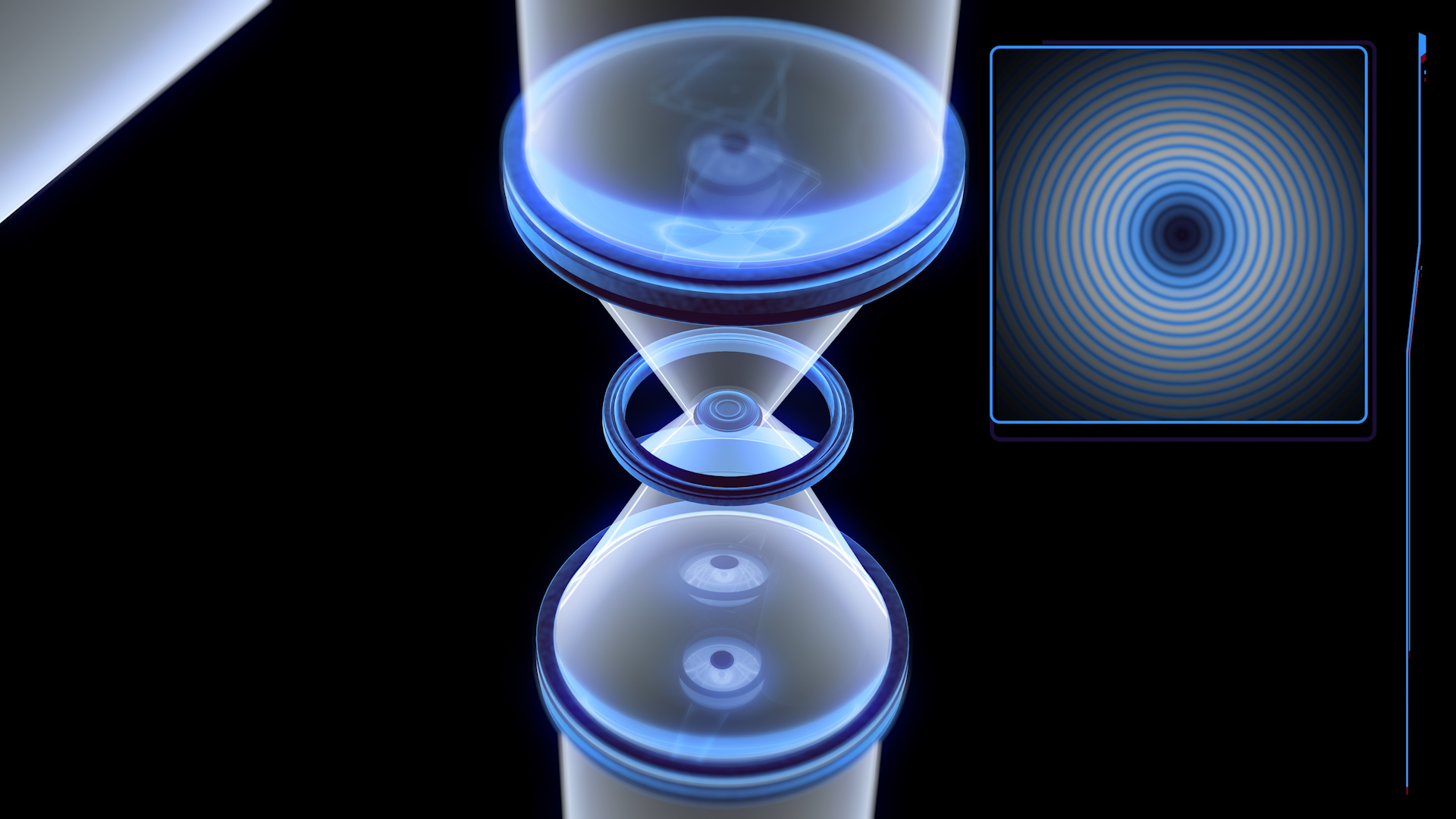
The coronagraph is a technology demonstration, not Roman's survey instrument. A mask alone fails because diffraction, mirror errors, vibration and thermal drift scatter starlight where a far fainter planet should appear. Roman adds wavefront sensing, two deformable mirrors with thousands of actuators, low-noise detectors and algorithms that maintain a dark region in the glare.
The difficulty is contrast, not raw angular resolution. A faint speckle created inside the telescope can resemble a planet and may change as the observatory warms or moves. Wavefront control measures those errors and reshapes the mirrors by minute amounts; later image processing separates residual instrumental patterns from persistent astrophysical light.
NASA targets two to three orders of magnitude beyond previous space coronagraphs, roughly 100- to 1,000-fold better contrast in relevant regimes. That is not a promise of 1,000 times the discoveries. Roman may examine older, colder, Jupiter-size planets and debris disks, not true Earth analogues. Its larger purpose is proving techniques a future Habitable Worlds Observatory could extend toward rocky planets. NASA's coronagraph description defines the demonstration role.
An inherited mirror in a difficult orbit
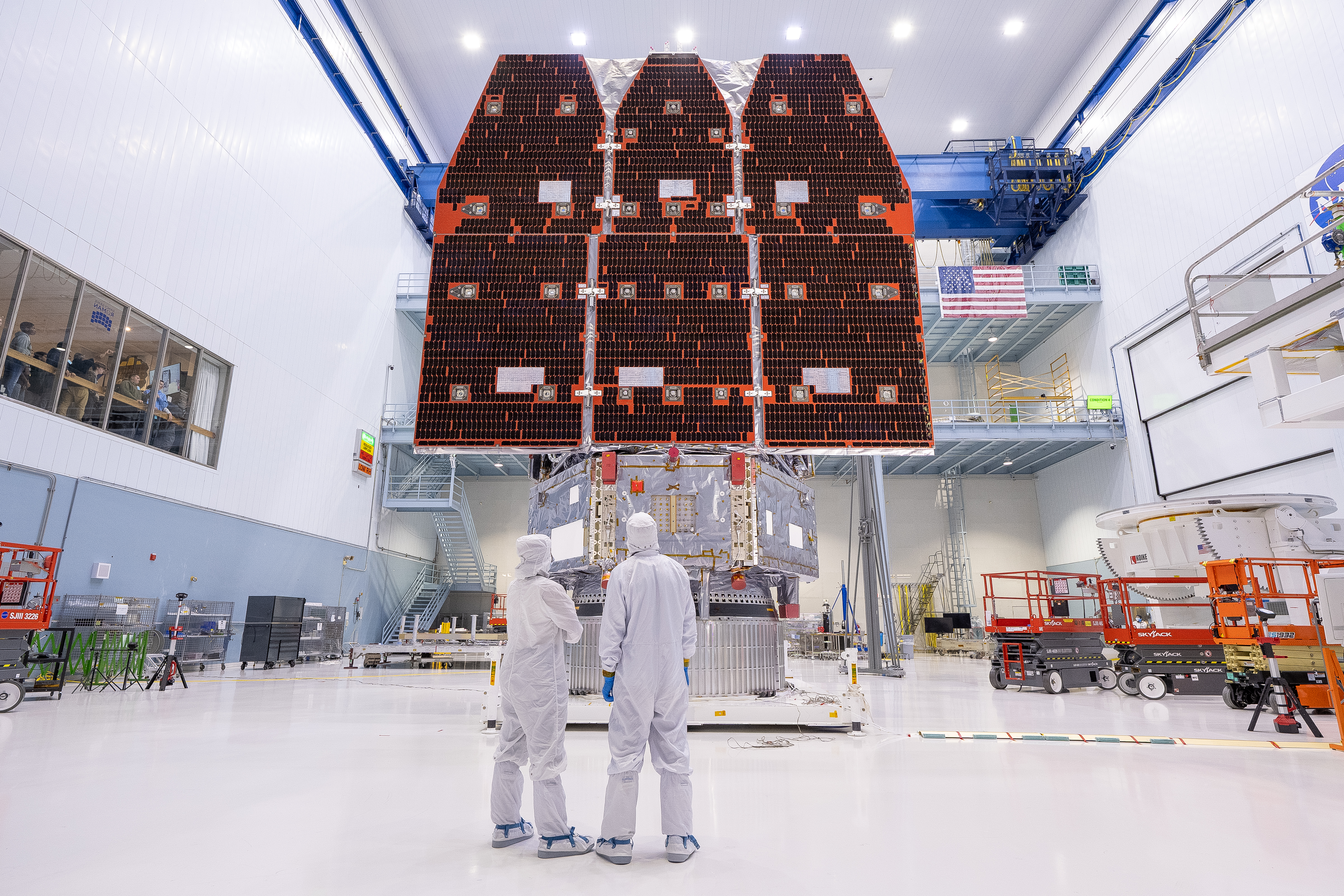
Roman's primary mirror is approximately Hubble's diameter but less than one-quarter the mass. The National Reconnaissance Office made key optics available to NASA. They never flew as an operational reconnaissance satellite. NASA received valuable, unused hardware, not a completed observatory awaiting a new name.
L3Harris reshaped and polished the primary, integrated nine other mirrors, qualified the assembly for cold and vibration, and applied a thin silver-based infrared coating. NASA reports a 410-pound mirror with roughly 1.2-nanometer average surface roughness. Every interface still had to fit Roman's wide-field optics, instruments, structure and thermal model. Heritage replaces some invention with known hardware, but creates integration and certification work when that hardware was designed for another system. NASA describes the completed optical assembly and mirror engineering.

Roman will not park motionless at L2. It will follow a quasi-halo orbit where Sun-Earth gravity and orbital motion make alignment with Earth practical using modest station-keeping. Sun, Earth and Moon remain on the same general side, enabling a consistent sunshade and solar-array orientation, long observations, little Earth obstruction, stable temperatures and predictable communications.

At 930,000 miles, astronaut servicing is impractical and bandwidth limits data return. Thrusters maintain the orbit and unload momentum, making propellant life-limiting. Roman supports possible robotic refueling, but no mission is guaranteed. Its primary mission is five years, with hardware intended for five more if fuel and health permit. NASA's technical page documents these constraints.
The telescope extends to Earth
Roman's instrument does not end at the focal plane. Packets must cross a million miles; ground stations receive them; pipelines remove instrumental signatures; archives preserve provenance; software creates searchable objects and histories. Goddard runs operations, STScI schedules and processes WFI imaging, and Caltech/IPAC handles high-level microlensing and slitless-spectroscopy products. Uncalibrated bits make an expensive radio transmitter.
Processing is iterative rather than a one-way conversion. Better detector models can require old exposures to be reprocessed; improved source catalogs can untangle blended spectra; cross-matches with other observatories can alter classification. An archive must retain raw measurements, calibration context, software versions and higher-level products so a future researcher can reproduce why a catalog entry exists.
Roman should transmit about 11 terabits, or 1.4 terabytes, daily through stations in New Mexico, Australia and Japan. NASA separately estimates 20 petabytes of observations across five years. One is daily spacecraft flow; the other is a mission-scale archive estimate. Higher-level products and reprocessing add work. NASA documents the downlink and 20-petabyte estimate separately.
Roman data will be public with no conventional proprietary period. A cosmologist can search for galaxy shear, an exoplanet researcher for microlensing, and a later team for an unanticipated transient. Automated classification is unavoidable because no group can inspect trillions of measurements. Simulations, anomaly detectors and machine learning must nominate sources while humans validate selection effects and failures. Openness expands the questions; reproducible pipelines keep answers credible. STScI's data plan explains the model.
GAO gives Roman a replanned life-cycle baseline of $4.316 billion. Calling the August launch nine months early compares it with the pandemic-era May 2027 commitment; against the original October 2026 target, it is about two months early. NASA's approximately $255 million SpaceX award covers launch service and related mission costs, not a retail rocket price. GAO's assessment and NASA's award provide the baselines.
Risk remains concentrated in launch and deployment. Detectors degrade; pointing or thermal drift blurs images; a small calibration bias can become a precise wrong answer. GAO says thermal-vacuum testing exposed a WFI communications fault, fixed by reprogramming, and microscopic ice requiring decontamination. Data bottlenecks can delay science, propellant limits life, and perfect operation may still leave several cosmological models viable.
A portrait is selected because someone knows where to point. A census asks how common an object is, what selection hid and which events were missed. Roman can turn one-off curiosities into populations, then flag the outliers that deserve Webb's sensitivity, Hubble's wavelength reach or a ground telescope's spectrum.
That shift changes discovery itself. A rare event no longer has to announce itself to the right observer on the right night. It can be recovered from a systematic record, compared with its peers and tested against the events that almost, but not quite, look the same.
Falcon Heavy is intended to place one observatory on a path away from Earth. What arrives scientifically is larger: optics, detectors, flight control, radiators, antennas, ground stations, calibration code, archives and researchers operating as one distributed instrument. If it works, Roman will make an immense, changing part of the sky searchable, moving astronomy from finding rare things by luck toward knowing how often the universe makes them.