Be careful what you wish for.
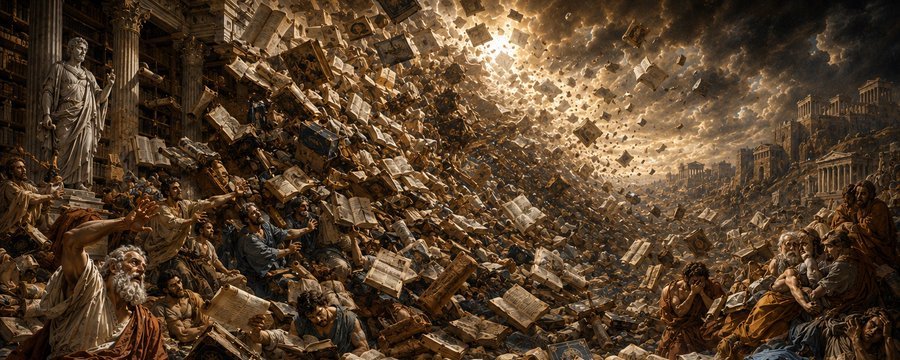
Every hour the world manufactures more letters, opinions, photographs, calculations, transactions, and declarations than a room full of scholars could examine in a lifetime. We have not solved the problem of knowledge. We have merely exchanged one inconvenience for another. It is as difficult to learn from a burned book as it is to learn from a library that grows faster than you can walk through it.
Man has always been fond of believing that more information naturally produces more wisdom. This is one of those cheerful ideas that survives chiefly because it has such pleasant manners. A warehouse full of facts does not amount to understanding any more than a warehouse full of lumber amounts to a cathedral.
The curious thing about history is that people often imagine it concerns the dead. It does not. History has always been a study of the living. Caesar, kings, revolutions, markets, inventions, and republics are merely different costumes worn by the same troublesome creature. The names change. The machinery changes. Human nature negotiates a far slower contract.
That is why history remains worth reading. It is less interested in telling us what happened than in reminding us what people are capable of doing when frightened, prosperous, hungry, triumphant, or absolutely convinced they cannot possibly be mistaken.
Perhaps that is where these new machines earn their keep.
Not because they are wiser than we are, but because they are patient enough to sift through mountains of evidence that would bury the rest of us. They may notice patterns no historian could hold in memory, connect events separated by oceans and centuries, or reveal relationships hidden beneath a weight of detail that no ordinary mind could ever carry.
They will not spare us from bad judgment. No machine has yet been invented that can rescue a determined fool from his favorite conclusion.
But they may give us something humanity has seldom possessed: the chance to observe ourselves with enough breadth that we stop mistaking the latest chapter for the entire book.
For most of history, we wandered in the dark because too little remained.
It would be a remarkable irony if, having finally illuminated the room, we discovered we could no longer see because the light had become too bright.