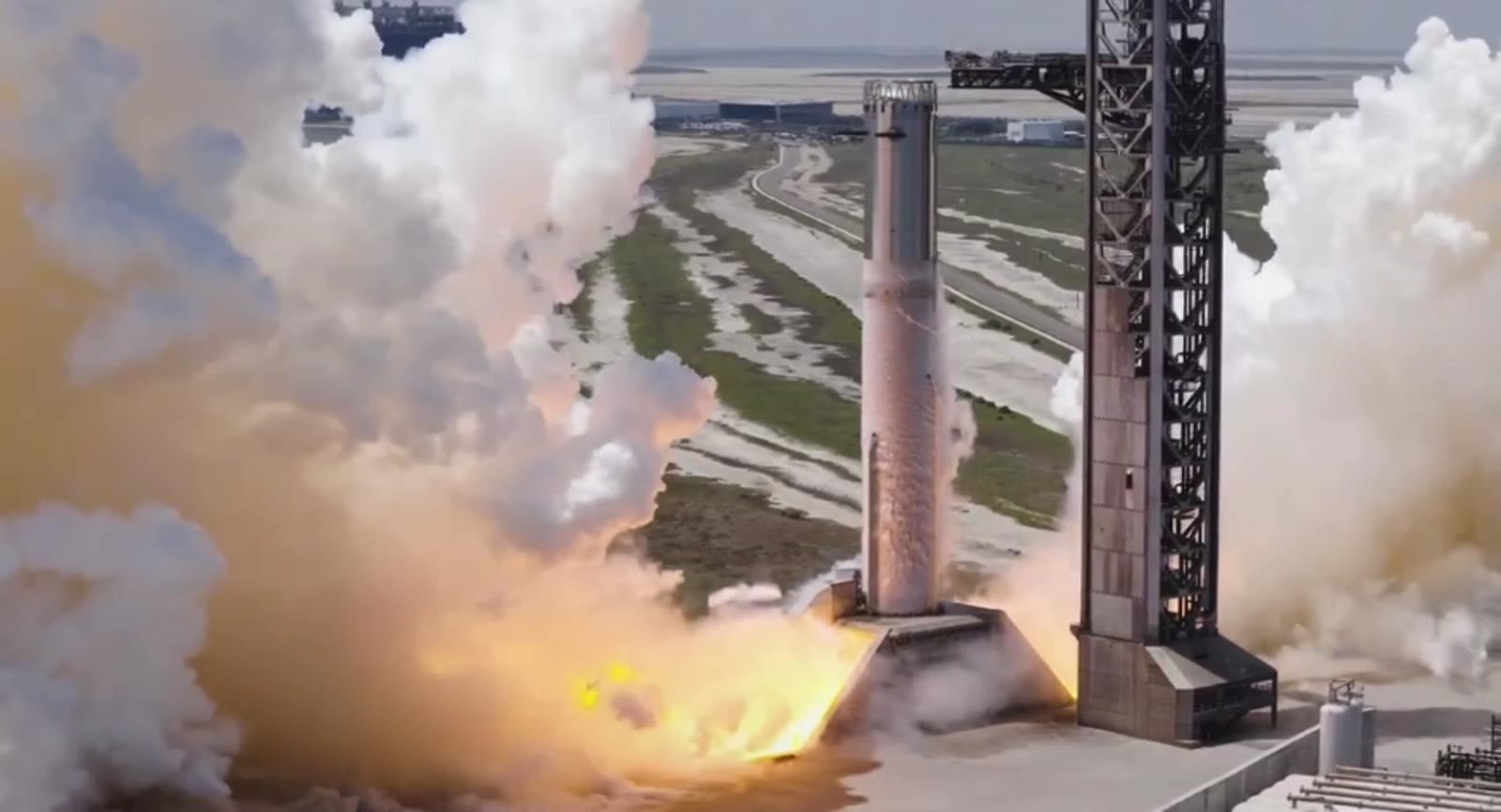
Thirty-three Raptor engines ignite beneath Super Heavy. Together they produce roughly 18 million pounds of thrust.
But the rocket doesn't move.
Watch what happens underneath it.
Everything in that video is trying to go somewhere.
The exhaust is being hurled downward into the flame trench. Water is exploding into steam. Pressure waves are moving through the air. And above all of it, Super Heavy is being pushed upward with enough force to lift thousands of tons.
Except SpaceX has deliberately locked it to the ground.
That creates a wonderfully simple engineering problem: if the engines are producing 18 million pounds of thrust and the rocket isn't going anywhere, where does all that force go?
The answer begins with about 20 pieces of machinery underneath the booster.
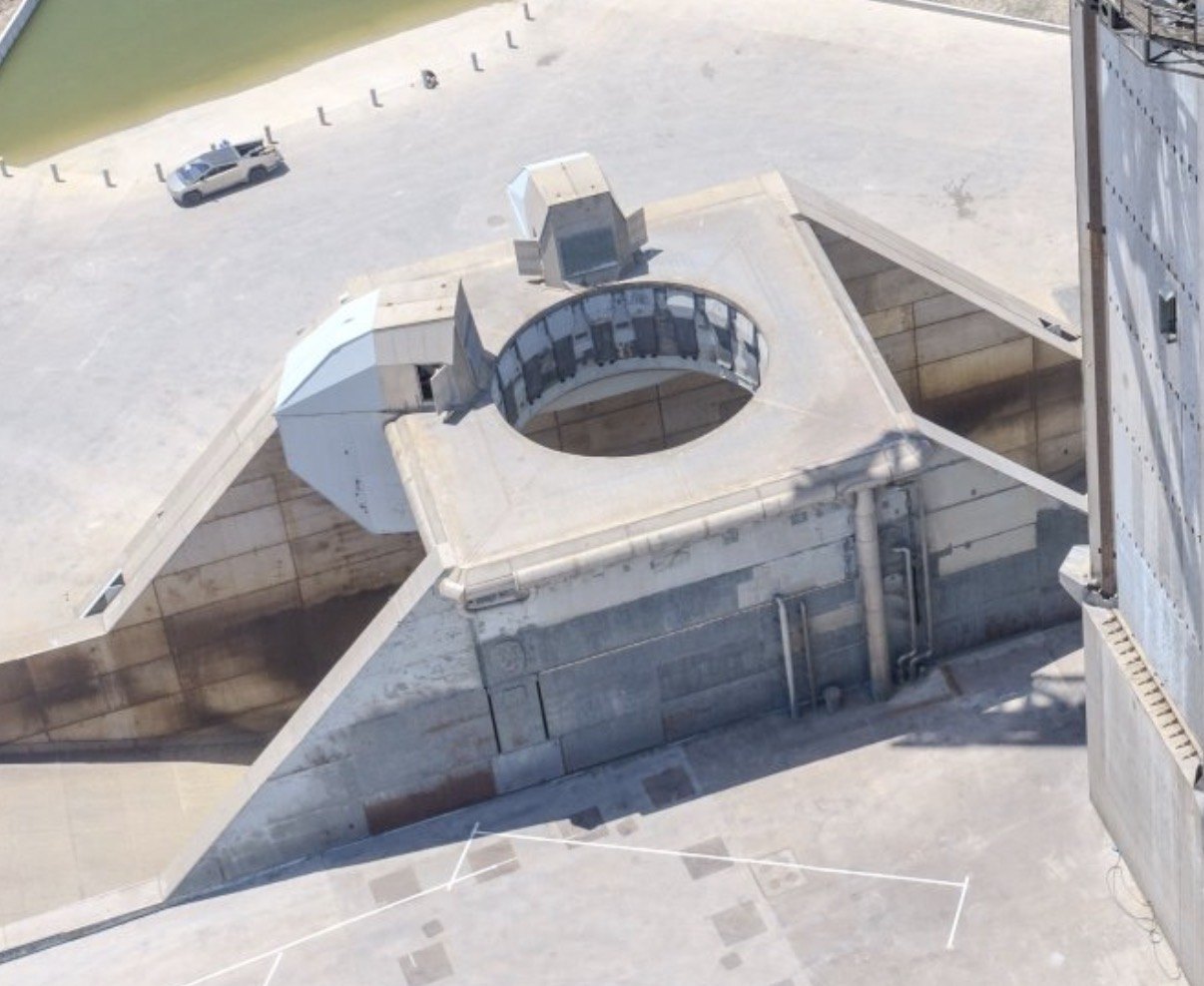
These are the hold-down mechanisms.
During a static fire, their job is almost absurd. SpaceX starts 33 rocket engines capable of launching one of the heaviest vehicles ever built, while these mechanisms prevent the booster from doing the one thing it was designed to do.
Fly.
The booster pulls upward. The hold-down system reacts against it. That load passes into the steel launch mount, through its supporting structure, into the foundations, and finally into the ground.
In other words, the rocket is trying to lift the launch pad.
And for the next several seconds, the launch pad has to win.
Where does 18 million pounds go?
Newton left engineers a particularly inconvenient rule: forces come in pairs.
Inside each Raptor, methane and oxygen react at enormous pressure and temperature. The resulting gas is accelerated downward through the engine nozzle. The gas is thrown toward the Earth. The engine is pushed the other way.
Up.
Do that with 33 engines and Super Heavy experiences millions of pounds of upward force.
During flight, that is precisely what you want. Once thrust becomes greater than the weight of the vehicle, the rocket accelerates upward.
During a static fire, however, the booster has been deliberately attached to the ground.
The force does not disappear merely because SpaceX has decided the rocket should remain where it is.
Something has to resist it.
At Starbase's newer Pad 2, Super Heavy sits inside a launch mount equipped with 20 hold-down arms. The booster tries to move upward. The hold-down system pulls back. The load enters the launch mount, then the structure beneath it, then the foundations, then the Earth.
There is no magic in the sequence. It is simply a load path, the same basic concept engineers use when designing a bridge.
A truck drives onto a bridge deck. The deck carries the load into beams. The beams carry it into bearings and piers. The piers carry it into foundations. The foundations spread it into soil or rock.
A rocket launch mount performs the same basic trick under considerably less civilized circumstances.
Instead of a truck sitting quietly on concrete, 33 rocket engines are operating a few dozen feet away.
The weight of the rocket helps
The launch mount does not necessarily have to resist the entire 18 million pounds as an upward hold-down load.
Gravity is already helping.
Suppose the engines produce an upward thrust T, while the booster has a downward weight W. Ignoring the complications for a moment, the force that must be supplied by the restraint system is approximately:
Hold-down force = Thrust - Weight
This distinction matters enormously.
Imagine setting a 100-pound box on the floor and pulling upward on it with 80 pounds of force. The floor does not need to hold the box down. Gravity is still winning.
Pull with 100 pounds and the box becomes effectively weightless.
Pull with 120 pounds and the box wants to leave. If you want it to remain on the floor, somebody now needs to provide the missing 20 pounds downward.
Super Heavy operates on the same principle, except the numbers have become offensive.
A fully fueled Super Heavy carries thousands of tons of propellant. At launch, much of the enormous engine thrust is initially consumed simply overcoming the vehicle's own weight.
A static-fire booster can be different. It does not necessarily need all the propellant required for an actual mission. It needs enough for the test, reserves, and whatever loading conditions engineers want to reproduce.
Remove propellant and the booster becomes lighter.
But the engines can still make enormous thrust.
Which leads to a wonderfully counterintuitive result.
A lighter rocket can be harder for the launch pad to hold down.
The vehicle looks less formidable because it contains less propellant, but gravity is contributing less downward force. More of the engine thrust must therefore be reacted through the restraint system.
A static fire is not merely a small version of a launch. Structurally, some parts of it can be a distinctly unpleasant test.
Twenty places to grab a monster
If we make a deliberately crude calculation, the scale becomes easier to appreciate.
Take Super Heavy's published maximum thrust of roughly 8,240 metric tons-force and divide it by 20 hold-down locations.
That is not the actual design load on each hold-down arm.
The booster still has weight. Loads will not divide perfectly evenly. Engine throttling, startup sequences, structural flexibility, dynamic effects, safety factors, geometry and the details of the restraint mechanism all matter. SpaceX has not publicly released enough engineering information to calculate the real load in each component.
But the arithmetic is useful because it puts us in the correct universe.
Hundreds of tons of force per attachment point is no longer an absurd estimate of scale.
And these are not simply 20 giant hooks bolted to a concrete slab.
The load must pass through connections, pins, actuators, plates, welds, beams and the larger launch mount without producing a local failure.
That last part is important.
A structure does not usually fail because someone forgot that 18 million pounds is a large number. It fails because the force found one particular piece of steel that was too thin, one connection that could not distribute the load, one weld subjected to an unfortunate stress concentration, one member that buckled, or one part of the system that vibrated in a way nobody expected.
Engineering enormous structures is often less about knowing the total load than persuading that load to travel through the structure politely.
Rocket engines are not especially polite.
The rocket is only one of the loads
If Super Heavy merely pulled upward with a perfectly steady force, designing the launch mount would already be difficult.
Unfortunately, it also happens to be a rocket.
Thirty-three engines do not produce a perfectly smooth mathematical arrow labeled THRUST.
They start. Turbopumps spin. Combustion chambers generate pressure fluctuations. Engines vibrate. Exhaust jets interact. Steel bends slightly under load. Acoustic waves strike structures and return.
The launch mount therefore experiences a combination of static and dynamic loading.
Structures care about how loads arrive. They care about frequency, duration, direction, repetition and temperature.
A full-power static fire is therefore partly an engine test and partly an interrogation of the ground system.
What moved? What heated? What vibrated? What strained more than predicted? What survived comfortably? What needs reinforcement before anyone puts a spacecraft on top and releases the hold-downs?
Computers can model the structure in extraordinary detail, but eventually the actual machine has to encounter the actual forces.
Reality is annoyingly good at finding assumptions hidden inside a model.
Then there is the exhaust
The structural reaction from the booster is only part of what Pad 2 has to survive.
Underneath the vehicle, 33 exhaust plumes carry tremendous momentum and thermal energy toward the ground.
This is a different engineering problem.
The main structural reaction travels through the booster and its hold-down system into the launch mount and foundation.
The exhaust travels downward.
The distinction is worth making because it is easy to look at a static fire and think the flame trench is somehow supporting the thrust.
It is not.
The hold-down structure is resisting the rocket. The trench is surviving what the rocket throws away. Those are two different fights occurring a few meters apart.
The exhaust can heat surfaces, erode material, create pressure loads and generate acoustic energy powerful enough to damage equipment beyond the immediate plume. Water helps absorb heat and modifies the brutal environment beneath the engines.
The launch site is not just stronger. It has to be arranged so fewer important things are standing where the rocket is trying to murder them.
Saturn V was smaller
The comparison with Saturn V is useful because Saturn V still occupies a peculiar place in the public imagination.
Its five F-1 engines produced roughly 7.5 million pounds of thrust at liftoff.
For decades that was the visual definition of an enormous rocket: five engines, a great white column of exhaust and a machine the height of a skyscraper slowly climbing away from Florida.
Super Heavy is in another class.
At roughly 18 million pounds-force, the booster can produce well over twice the thrust of Saturn V's first stage.
And it does it using one liquid-propellant stage.
The number is impressive during launch.
During a static fire it becomes almost surreal.
Imagine building something substantially more powerful than the first stage of Saturn V, starting every engine, bringing the propulsion system to enormous thrust, and then intentionally preventing the machine from going anywhere.
That is the job of the launch pad.
The hidden machine
Rockets receive most of the attention because rockets move.
Launch infrastructure has the misfortune of remaining approximately where it was built.
But reusable rockets increasingly make the ground system just as interesting as the vehicle.
SpaceX wants Super Heavy to fly, return to the launch site, be caught, serviced, stacked with another ship and flown again. Its usefulness therefore depends not merely on whether the booster survives.
The pad has to survive too.
And not once. Again and again.
That changes the engineering objective.
An expendable launch system can tolerate infrastructure that requires substantial refurbishment between missions. A transportation system cannot. Every damaged pipe, overheated component, cracked surface, distorted piece of steel and lengthy inspection eventually becomes part of the turnaround time.
The rocket kept getting more capable.
So the ground had to evolve with it.
That is the part easy to miss when a Super Heavy static fire disappears behind a cloud of steam.
The spectacular machine is the stainless-steel cylinder above the flames. But underneath it is another machine made from concrete, steel, pipes, valves, foundations, sensors and water.
For several seconds during a static fire, those two machines are fighting each other.
Thirty-three Raptors are trying to make Super Heavy leave Texas.
Twenty hold-downs and several thousand tons of infrastructure are making sure it does not.
And when the engines finally shut down and the booster is still sitting exactly where it started, the most impressive thing the launch pad has done is nothing at all.