
During the Second World War, the United States Army employed people under the literal occupational title of computer. They worked through ballistic calculations with desk calculators, mathematical tables, worksheets, and a patience the arithmetic drew down hour by hour, showing no particular concern for whether any would remain by evening. Their job was to take the equations of physics and coax from them numbers useful to people who could not afford to wait for mathematics to finish at its leisure.
The difficulty was not that humanity lacked mathematics. Scientists and engineers already possessed equations capable of describing remarkably complicated things.
The trouble came afterward.
Reality could happen considerably faster than the arithmetic describing it.
Artillery supplied more than enough proof.
U.S. 105 mm howitzers fire near Bertrichamps, France, in November 1944, supporting the advance toward Raon-l’Étape. The shell crossed the sky faster than the arithmetic could follow.
A shell is a simple object only while it is sitting still. The moment it leaves the barrel, the universe develops opinions about where it ought to go. Gravity reaches for it immediately. The atmosphere leans against it for the whole journey. Wind alters its motion through the air. Most troublesome of all, the shell is constantly changing speed, and that changes the drag acting upon it, which changes the speed again. The calculation therefore refuses to stay put. Every answer becomes part of the next question. At sufficient range, even the rotation of the Earth has the poor manners to become relevant.
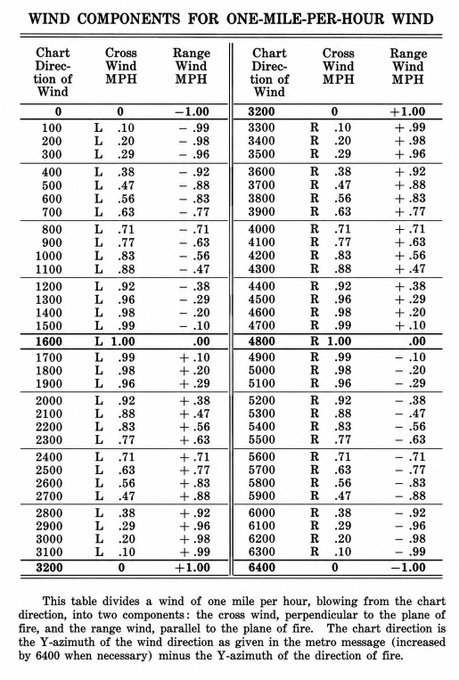
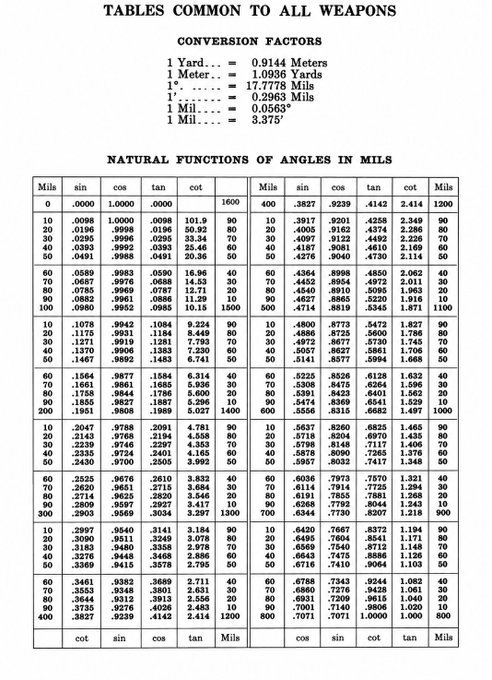
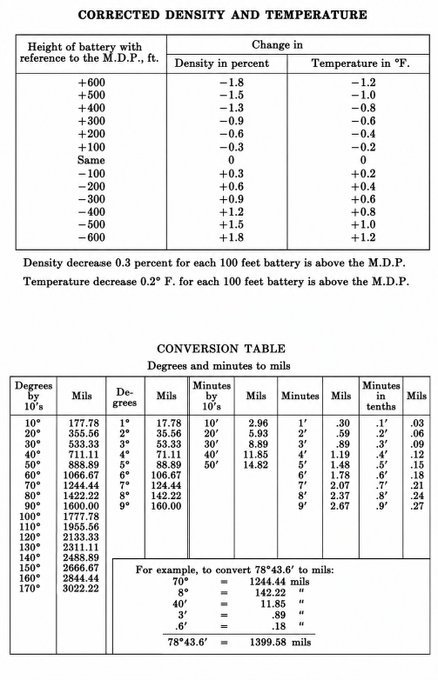
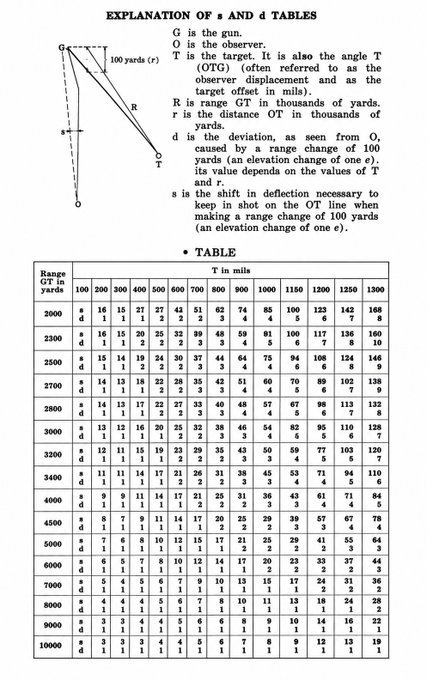
A firing table looked simple enough once printed. Rows, columns, corrections, ranges, and elevations stood neatly in place as though they had arrived there without difficulty.
They had not.
Each number represented mathematics already worked to a conclusion somewhere else by somebody with considerably more time than the person consulting it in combat. The table was not merely information. It was hours of calculation pressed flat enough to fit in a soldier’s hands.
The method worked perfectly well, provided nobody was in a real hurry.
A representative ballistic trajectory lasting about 60 seconds in the physical world could require roughly 20 hours for a skilled human computer using a mechanical desk calculator to work through numerically. The shell could leave the gun, cross the sky, strike the ground, and settle the whole affair in a minute. The arithmetic, unmoved by the spectacle, might still be sitting at its desk the following afternoon.
The problem was not a shortage of equations, nor of people clever enough to understand them. An equation, once discovered, simply did not consider itself responsible for producing the answer. Hundreds or thousands of operations still stood between the question and the useful number.
By the 1940s, humanity had become better at asking mathematical questions than at finishing them.
Calculation itself had become the bottleneck.
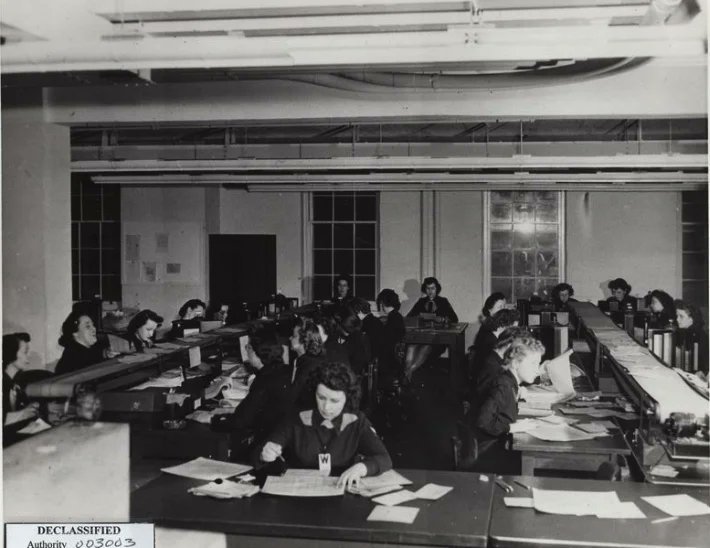
People had been trying to escape arithmetic by machinery for centuries, but machinery had a tiresome habit of inviting the physical world along.
Mechanical calculators offered one of the first great reprieves. By the early twentieth century, offices, laboratories, engineering firms, insurance companies, and government agencies were filled with machines that could add, subtract, multiply, and divide using gears, wheels, levers, and cranks. They were much faster than arithmetic by hand and possessed the agreeable quality of never complaining about another column of numbers.
They were also magnificently incurious.
A person entered the numbers, operated the machine, recorded the result, and decided what came next. The calculator knew nothing of trajectories, shells, or why anybody had brought all these figures into the room. Give it two numbers and an operation and it would work faithfully enough. Ask what ought to happen next and the machine became suddenly innocent of the entire affair.
The calculator supplied the arithmetic, but the sequence still belonged to the person. Results had to be read, recorded, carried forward, and returned as inputs for the next operation. Every answer merely handed the human another question.
Humanity had taught a machine to work the numbers, but not yet to keep track of what the numbers were doing.
Another kind of machinery attacked a different part of the problem.
Punched cards gave information a physical form that machines could recognize. Names, quantities, categories, and other facts could be translated into patterns of holes, stored on stiff cards, and fed back into machinery later.
The abstract had been punched into cardstock and put to work.
This did not make the machine understand the information. It did something immediately useful: it made large quantities of information manageable by machinery.
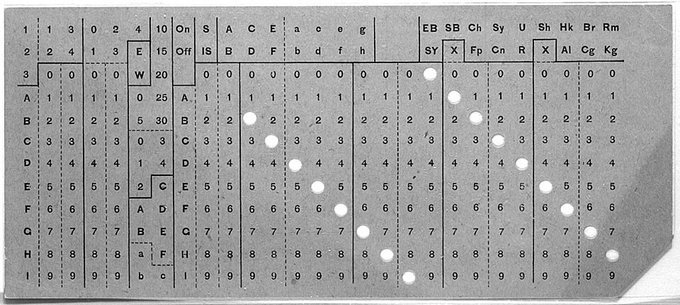
Businesses and government agencies had accumulated records faster than clerks and filing cabinets could comfortably digest them. Once information had been encoded onto standardized cards, machines could begin dealing with it in crowds.
A fact no longer had to wait for a person to find it, count it, and put it back where it belonged. Given the proper holes, machinery could sort, count, compare, and tabulate enormous stacks of information.
Data behaved beautifully when it agreed to stand in line.
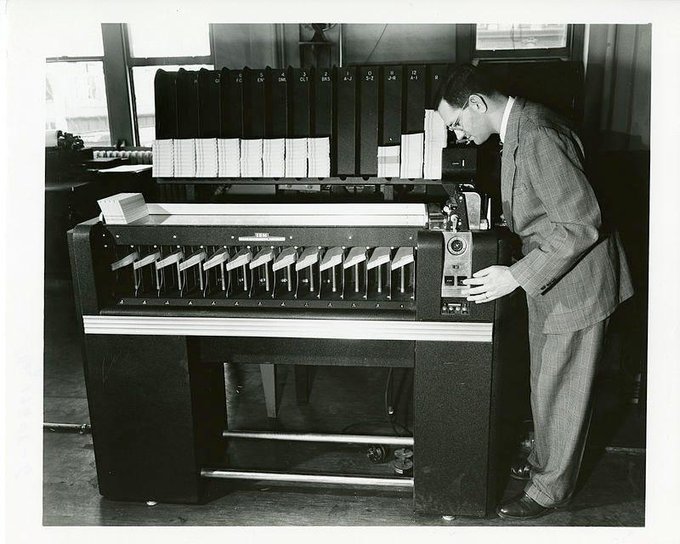
Names, wages, inventories, census records, and other respectable facts took naturally to punched cards. Once a fact had been punched into the proper holes, it could be sorted and counted with a discipline difficult to achieve by the people the facts described.
Ballistics presented a different sort of nuisance.
A firing table was not merely a collection of facts waiting to be organized. It had to be created by following mathematical relationships as quantities changed together. What engineers needed was machinery capable of staying with the mathematics while the answer was still becoming itself.
The result looked rather like what you might get if you told a mechanical engineer to invent a calculator.
If mathematics insisted upon changing continuously, machinery might as well be made to suffer along with it.
It was called the differential analyzer.
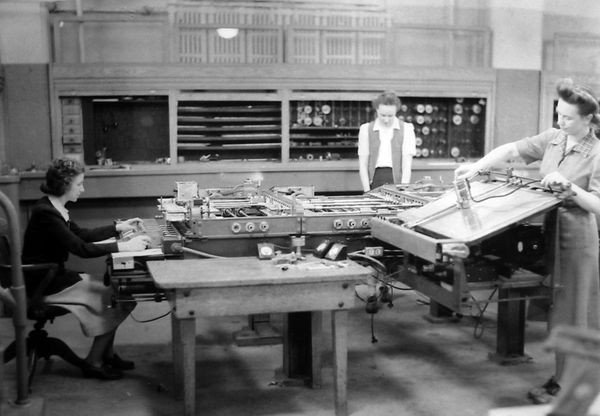
The differential analyzer was an analog calculating machine. Instead of representing every quantity as a written number, it could let the position of a shaft or the rotation of a disk stand for one. Connect the machinery properly and one motion influenced another according to the mathematical relationship being studied.
Shafts turned, disks rolled, gears carried motion from place to place, and mechanical integrators accumulated the result. The machine looked less as though it were solving an equation than as though the equation had been taken apart, issued iron parts, and instructed to demonstrate itself in public.
That was the clever part. An equation might describe continuous change in a few lines, while following everything those lines implied could keep a person occupied for hours. The differential analyzer handed that long pursuit to machinery. Instead of a human repeatedly calculating what happened next, shafts and disks followed the changing quantities as they went.
And, to its credit, it worked. A ballistic calculation that could consume hours of human effort might now be worked through mechanically in a fraction of the time.
But putting mathematics into machinery also meant giving mathematics all the inconveniences of machinery.
Gears had tolerances. Shafts had weight. Bearings developed friction. Surfaces slipped. Parts wore. An equation could demand a perfectly smooth change without the slightest concern for whether a bearing agreed.
Mathematics could be elegant. Steel had to drag that elegance through the physical world.
The differential analyzer had shown that machinery could take over far more of a calculation than a desk calculator ever could, but another path was developing alongside it.
This one was digital and electromechanical.
Bell Telephone Laboratories built increasingly sophisticated relay calculators. Howard Aiken’s Harvard Mark I, completed during the war with IBM’s assistance, could execute long sequences of calculations automatically.
The important word was automatically.
The machine no longer needed a person to carry every result by hand from one operation to the next.
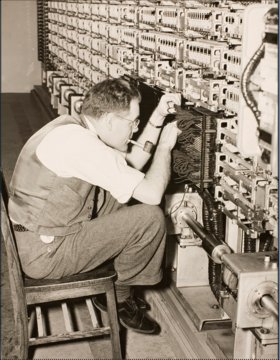
This was a major advance. Instructions could be arranged beforehand, intermediate results could pass automatically from one operation to the next, and long sequences of calculation could proceed with far less human intervention. The machine was beginning to carry not only the arithmetic, but the procedure.
The arithmetic had learned to walk unattended.
It was still walking on metal legs.
Current passed through a coil, the coil created a magnetic field, and the magnetic field tugged a little metal armature into motion. The armature crossed its tiny distance, opened or closed a set of contacts, and only then did the rest of the circuit receive permission to proceed.
It was an ingenious arrangement, dependable and respectable, but it made a surprisingly elaborate ceremony out of saying yes or no.
The electrical signal itself had arrived almost at once. The relay, however, believed in procedure. The armature had to start moving, cross the gap, meet the contact, settle itself, and later make the return journey. To a person, the distance was minuscule. To a calculating machine, which intended to repeat that little journey thousands upon thousands of times, it was enough to become a grievance.
A thousandth of a second is a very small thing until it finds several thousand friends.
Engineers could lighten the armature, improve the contacts, and coax every fraction of speed from the relay that good workmanship would permit. But it remained a piece of matter. Electricity might deliver the order instantly. The armature still insisted upon traveling there.
What computing needed was a switch with no journey to make.
Radio engineers already had one.
The moving switch had disappeared. Electricity could now control electricity.
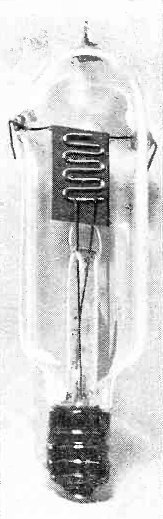
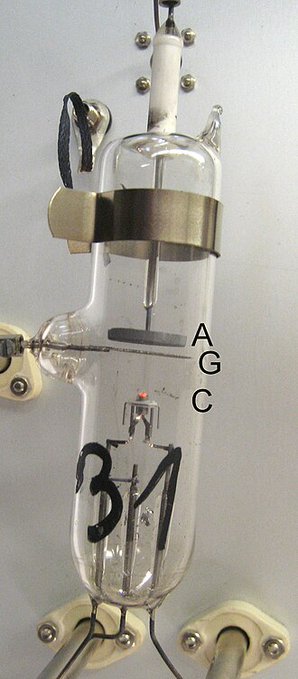
Inside the vacuum tube, most of the air had been persuaded to leave. A heated cathode gave electrons enough encouragement to depart, another electrode drew them across the empty space, and a control grid between the two decided how freely they might pass. Change the voltage on that grid and the current could change almost at once.
No armature had to cross a gap. No contacts had to meet before the circuit could change its mind.
The relay had required electricity to move matter so that matter could tell electricity what to do next.
The vacuum tube dispensed with the middleman.
Switching became dramatically faster.
Naturally, the vacuum tube had not come to perform miracles for free. Its cathode had to be kept hot, and heat has never shown any talent for minding its own business. The heater wanted electricity. The tube wanted a socket, the socket wanted wires, and the wires soon acquired supporting parts of their own. What began as a remarkably fast switch brought along nearly everything required to keep it alive.
One tube was a clever device.
A few thousand became an engineering problem.
At the Moore School of Electrical Engineering at the University of Pennsylvania, John Mauchly had been considering what might happen if electronic switching were turned loose on serious numerical calculation. J. Presper Eckert understood the harder question: not whether one vacuum tube could work, but whether thousands of them could be persuaded to work together long enough to be useful.
On paper, thousands of components were perfectly agreeable.
The difficulty was maintaining those components.
The Army’s need for firing tables was growing faster than the calculators could keep up. Mauchly saw how electronics might supply the speed. Eckert understood what would be required to make that speed survive contact with actual hardware.
The pieces found one another: a military need, an ambitious idea, an engineer capable of making it work, and enough money to discover which objections nature intended to raise.
The result was the Electronic Numerical Integrator and Computer.
ENIAC.
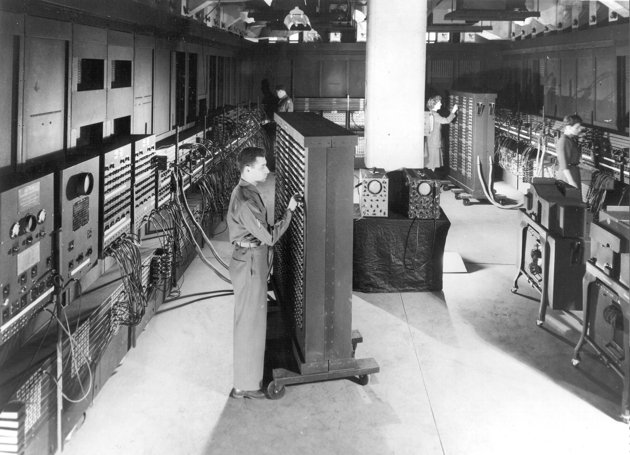
Development began in 1943. By early 1946, ENIAC was ready for public demonstration, and there was no mistaking that arithmetic had become a physical undertaking.
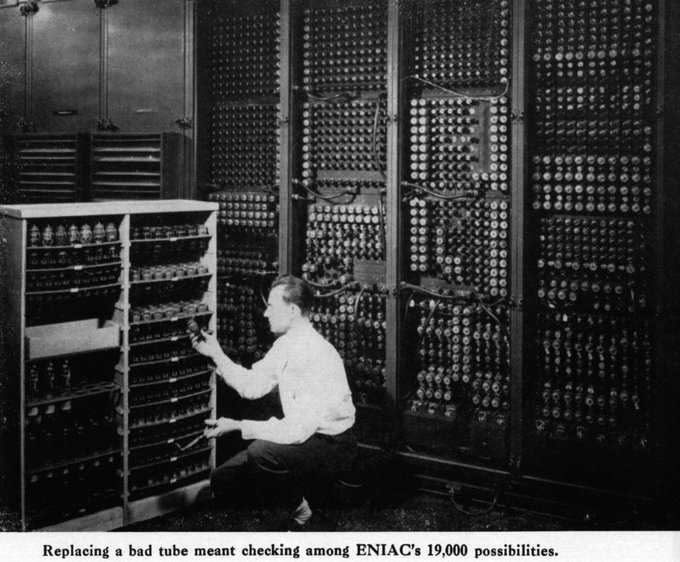
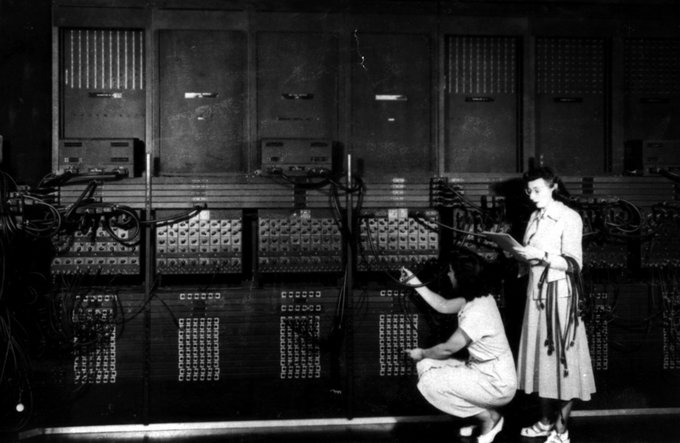
The machine weighed about 30 tons and wrapped itself around three sides of the room in a great U. Its panels contained roughly 18,000 vacuum tubes, 70,000 resistors, 10,000 capacitors, 1,500 relays, and enough wiring to make every calculation a considerable act of cooperation.
There was nothing abstract about computing here. Numbers occupied actual hardware. Signals traveled through actual wires. Every addition, multiplication, and intermediate result had to find its way through some particular part of the machine, and thousands of parts had to agree on what happened next.
The cabinets towered over the people working among them, crowded with switches, lamps, dials, sockets, and cables. A human computer had once done the arithmetic at a desk. ENIAC did it thousands of times faster, but only after arithmetic had been provided with its own room, electrical supply, cooling, and a great many things that could go wrong.
This was electronic computation in 1946.
The arithmetic had become wonderfully fast.
Everything around it had become enormous.
The arithmetic was electronic. Everything required to produce it remained stubbornly physical.
The machine also ate electricity with conviction. Its demand was roughly 150 kilowatts. That may not sound extraordinary beside a modern data center, but in the 1940s the average American household used only about 1,400 kilowatt-hours in an entire year. Run continuously, ENIAC could consume roughly as much electricity as nearly a thousand American homes of the period.
Much of that power was spent keeping thousands of vacuum tubes hot. Then came the blower, which required still more electricity to carry away the heat those tubes produced.
With the relay, the trouble had been mechanical. The armature had mass, and mass took time to move. The vacuum tube escaped that delay by doing away with the moving switch, but its cathode had to be kept hot. Multiply that heat by thousands of tubes and a new problem appeared.
Engineers had escaped the laws of motion only to run into the laws of thermodynamics.
The bottleneck had moved.
ENIAC was enormous, hot, expensive, and so troublesome that the arithmetic sometimes seemed the easiest part.
But the arithmetic was astonishing.
ENIAC could perform about 5,000 additions per second. The Harvard Mark I required roughly four-tenths of a second for an addition. On that basic operation, ENIAC was about 2,000 times faster.
The difference was just as dramatic in the problem that had started the whole affair. A representative ballistic trajectory lasting about 60 seconds could require roughly 20 hours with a desk calculator and about 15 minutes on a differential analyzer.
ENIAC could calculate it in roughly 30 seconds.
For years, reality had outrun the arithmetic.
Electronic computation was beginning to catch it.
Human beings took this improvement with their customary restraint and immediately asked for more.
Calculations that had once been dismissed as too expensive in time suddenly looked affordable. Ballistics had opened the door, but weather, aerodynamics, atomic research, engineering, and other fields with large appetites for arithmetic soon came through behind it.
When calculation took days or weeks, many useful questions simply were not worth asking. Once the same work could be compressed into minutes or seconds, those questions became practical.
Science had discovered a bargain and, as usual, began filling its cart.
Electronic computing had not merely made old calculations faster. It had begun changing which calculations people considered worth attempting.
There remained, however, the awkward business of telling 30 tons of electronics exactly what to do.
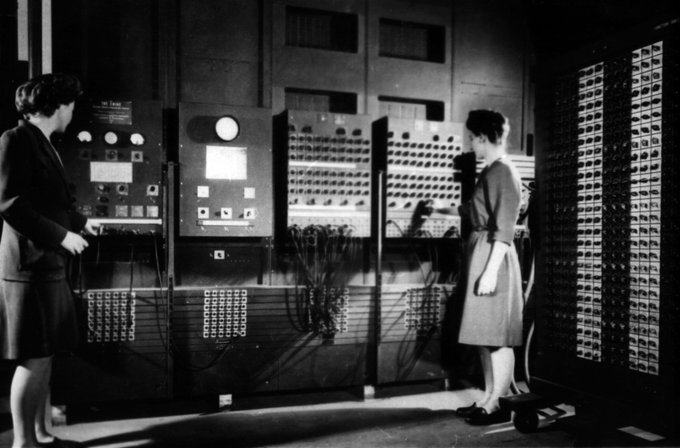
Six women from the Army’s human-computing operation became ENIAC’s original programmers: Kathleen McNulty, Frances Bilas, Betty Jean Jennings, Ruth Lichterman, Betty Snyder, and Marlyn Wescoff.
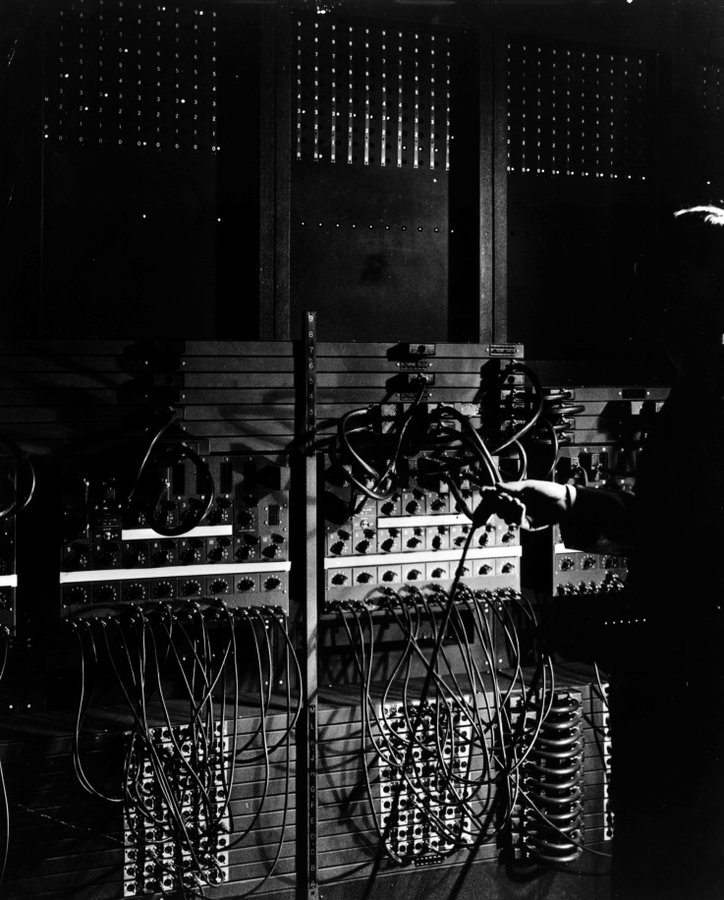
Programming ENIAC meant taking a calculation that existed on paper and deciding how 30 tons of electronics would carry it out. The programmers had to understand the mathematics, decide which parts of the machine would perform each step, determine where the results should go next, and then arrange the necessary cables and switches.
A calculation that ENIAC could finish in seconds might therefore take hours to prepare. The machine had become astonishingly fast at arithmetic before programming it had become particularly convenient.
Later computers would solve much of that problem by storing their instructions electronically.
But easier programming would not make the thousands of vacuum tubes disappear.
Vacuum tubes have since acquired a reputation for failing so constantly that early electronic computing can sound like a highly organized form of lamp replacement.
The truth was less theatrical and more impressive.
ENIAC’s engineers knew perfectly well that 18,000 tubes constituted an invitation to trouble. They operated them conservatively, tested components, standardized circuits, improved maintenance procedures, and became very good at discovering which small part had decided to resign.
During mature operation, a tube might fail roughly every day or two rather than every few minutes.
That was a considerable triumph.
It was also a curious kind of triumph, because replacing a failed vacuum tube every day or two had become evidence that things were going rather well.
And the tubes did not enjoy a monopoly on misbehavior. Solder joints could fail. Connections could become intermittent. Heat could alter electrical behavior. Power disturbances could upset circuits.
A machine containing tens of thousands of components did not require an organized rebellion.
One well-placed traitor could ruin the afternoon.
Scale had introduced another kind of problem: even very reliable parts become interesting when you own enough of them.
The machine did not need one component to work. It needed thousands of them to keep working together.
The arithmetic was plain enough. If a machine depended upon every part doing its duty, then every new part was another opportunity for something to go wrong. A component could be wonderfully reliable on its own and become considerably less comforting once it had several thousand companions.
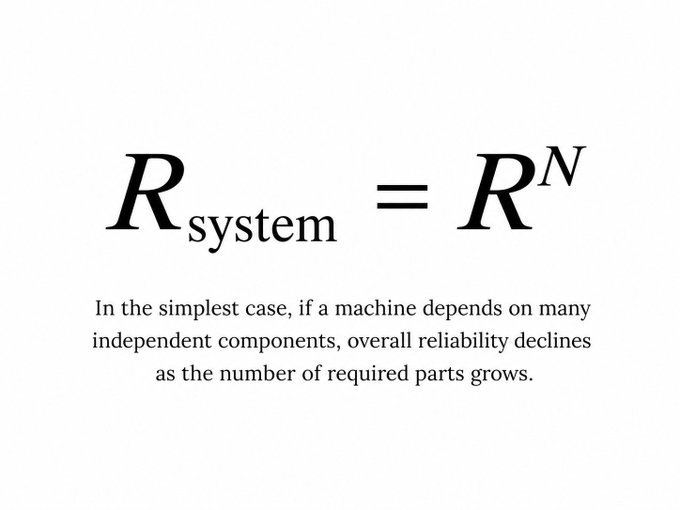
ENIAC had about 18,000 vacuum tubes, and the tubes were only the beginning. There were sockets, resistors, capacitors, solder joints, connections, and miles of wiring, each perfectly capable of causing trouble without consulting the others first.
One part could fail occasionally.
Thousands of parts could take turns.
And failure was only one price of multiplication. Every additional tube wanted electricity, produced heat, needed a socket, and brought more wiring and supporting components with it. Those components needed cabinets. The cabinets needed floor space. And somebody needed enough room to get inside when one small part decided to occupy the afternoon.
A single vacuum tube was an electronic switch.
Thousands of them were a system that had to be kept alive.
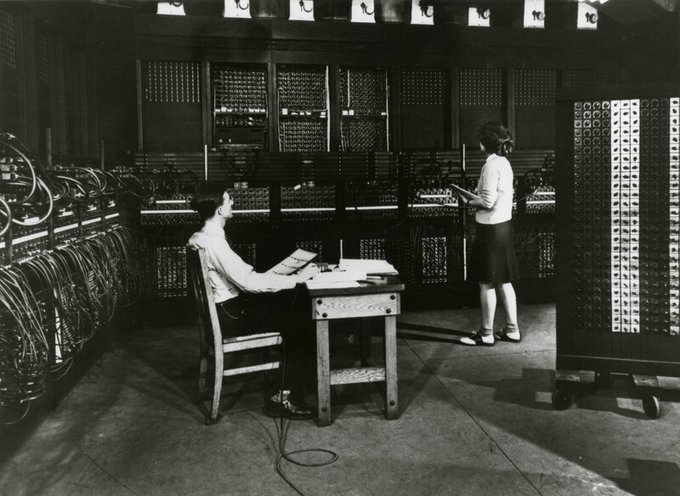
ENIAC had answered the old question. Arithmetic could be made electronic, and electronic arithmetic could be astonishingly fast.
The next question was less cheerful.
How much machinery would be required to make still more of it?
This was not a difficulty anybody needed to invent. It followed naturally from the success of the machine. If electronic computation was useful, people would want more electronic computation. And with vacuum tubes, more computation still meant more physical machine.
That had been the pattern from the beginning. Human calculation was too slow, so mechanical calculators took over individual operations. The human still had to conduct the calculation, so engineers built machinery capable of following more of the mathematics itself. Relays automated long sequences, but every decision still required a little piece of metal to travel somewhere. Vacuum tubes removed the moving switch and gave arithmetic electronic speed.
Each solution had pushed the obstacle farther down the road.
Now the arithmetic was fast.
The computer was enormous.
If the future required vastly more computation, it could not simply consist of building larger and larger rooms full of vacuum tubes until somebody ran out of floor.
The machine itself had become the bottleneck.
At Bell Telephone Laboratories, engineers had arrived at much the same complaint by another road.
Another industry had begun arriving at the same complaint by a different road.
The telephone network possessed an extraordinary ability to take a small engineering inconvenience and repeat it until the inconvenience acquired a budget.
A vacuum tube that consumed a little too much power, occupied a little too much space, or failed a little too often might be tolerable by itself. Scatter the same habits across a continental communications system and the inconvenience became considerably more persuasive.
Bell Labs wanted something smaller, cooler, longer-lived, and less demanding.
Researchers had been studying semiconducting materials, whose electrical behavior suggested that amplification and switching might be possible without a hot cathode glowing inside an evacuated glass envelope.
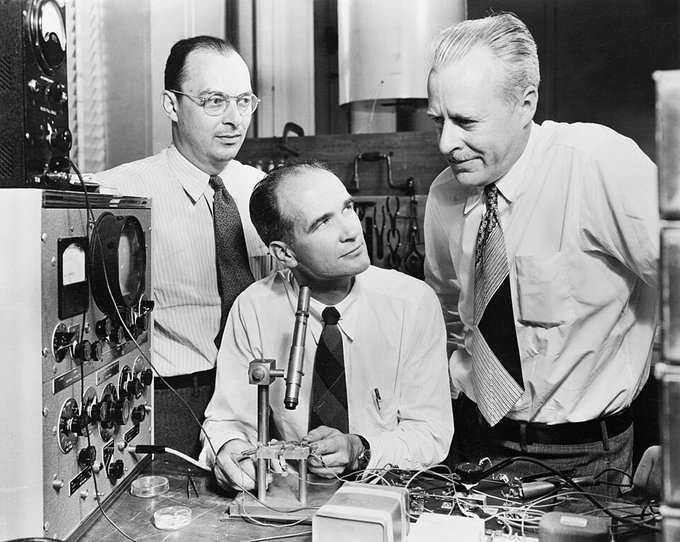
Then, in December 1947, John Bardeen and Walter Brattain, working within William Shockley’s research group, demonstrated a peculiar little device involving germanium and closely spaced electrical contacts.
It did not glow.
It did not require a room.
Considering the history that had brought computing this far, those were already remarkable qualifications.
The next revolution did not look more powerful. It looked smaller.
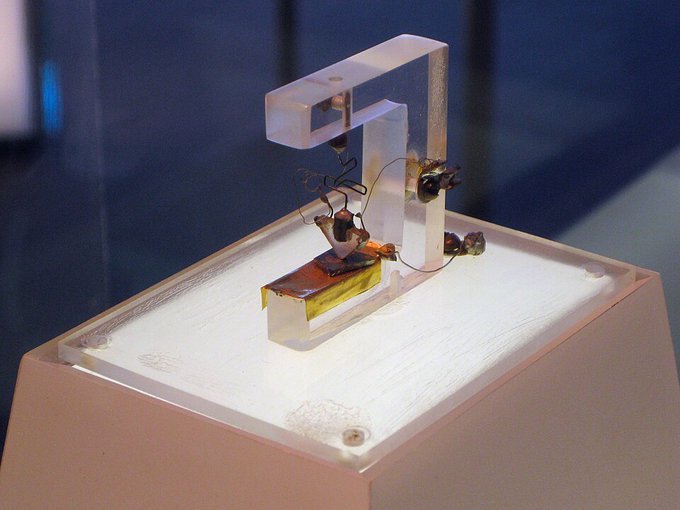
The transistor could amplify an electrical signal, and it could switch one. The first device was crude, delicate, difficult to manufacture, and so physically unimpressive that a sensible person might have mistaken it for something left over after the experiment.
After ENIAC, this modesty was refreshing.
Vacuum tubes were established technology. Engineers knew how to build them, wire them, cool them, and tolerate their peculiarities. The transistor was a laboratory upstart with uncertain prospects and most of its education still ahead of it.
But it had already proved something more important than usefulness.
The vacuum tube’s inconveniences were not laws of nature.
Electronic switching did not have to mean hot cathodes, glass envelopes, great quantities of power, and enough supporting machinery to interest the building superintendent.
Computers did not have to glow.
For years, engineers had been learning how to make calculation faster. Electronic computing had finally brought arithmetic close to the speed of the world it described.
Now another constraint had taken its place.
The next problem was not simply how to make the calculation faster.
It was how to make the calculator smaller.